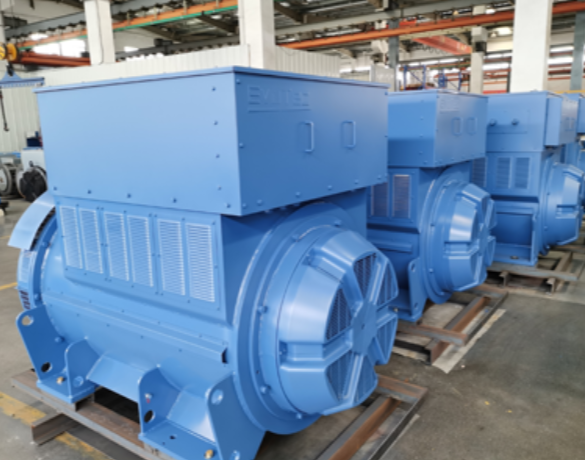
Comparative lead: why this design choice matters now
Choosing between single-bearing and double-bearing architectures shapes reliability, service windows, and fabrication workflows for high-output alternators used in marine powerplants. This comparative look targets engineers and product owners who must decide on alternator topology for kilovolt-ampere-class systems — from a 3 mw generator used in offshore modules to shore-side 3500 kva generator sets. Early trade-offs show up as vibration signatures, axial load handling, and maintenance cadence; these are the levers that determine uptime and lifecycle costs.
Core structural differences and immediate operational effects
Double-bearing designs add a second radial support near the drive end or non-drive end, reducing shaft deflection under torque and cutting vibration transmission into the stator. The rotor stays better centered, which means less eccentricity in the air gap and more consistent voltage output under varying loads. In fabrication, that translates into tighter tolerances on the housing bore and more deliberate alignment procedures. Assembly time increases slightly, but run-in periods and break-in tests tend to shorten, improving first-run yield.
Performance metrics where double-bearing wins
Measured against standard acceptance procedures — vibration amplitude, bearing temperature rise, and load acceptance response on a calibrated load bank — double-bearing machines routinely show lower peak vibration and smaller temperature gradients at rated load. MTBF trends favor the double-bearing layout in continuous, heavy-load applications typical of marine auxiliary power and emergency systems. The marginal cost of the extra bearing often pays back in reduced unscheduled maintenance and fewer rotor replacements over the generator’s service life.
Operational production teardown: what to inspect on the line
When you run an operational production teardown — comparing a 3500 kva generator and a 3 mw generator in side-by-side builds — focus on rotor runout, bearing preload, and shaft coupling alignment. Check stator core assembly for uniform impregnation and inspect thermal management channels for coolant or air-flow blockages. These checkpoints reveal whether the double-bearing approach is executed properly in fabrication or merely a spec on the drawing. Proper assembly reduces harmonic heating and improves excitation stability under dynamic loading.
Manufacturing and field-testing trade-offs
Fabricators face a few concrete trade-offs: slightly higher material cost and a need for precision machining versus better resistance to axial thrust and fewer in-service realignments. For marine environments, corrosion-resistant bearing housings and robust seals are necessary — salt spray exposure accelerates wear if neglected. Field-testing should include sustained load runs that simulate surge events seen during port grid disturbances — lessons learned from Hurricane Sandy in 2012 showed how extended outages force continuous loads that expose design weaknesses in single-bearing alternators.
Common mistakes and how teams correct them
Teams often underestimate the importance of bearing preload control and torque sequencing during assembly — small errors amplify under high kVA output. Another frequent misstep is inadequate coupling balance, which negates the benefits of a second bearing. Fixes are straightforward: enforce calibrated torque tools, add dynamic balancing at rated rpm, and record baseline vibration spectra for trend analysis. These steps reduce margin-of-error in both factory and shipboard commissioning.
How to choose between single- and double-bearing for your project
Selection depends on operating profile. For intermittent or low-duty gensets, single-bearing can be lighter and cheaper. For continuous heavy-duty or critical backup roles — typical of offshore platforms and major port facilities — double-bearing offers measurable resilience. Evaluate expected axial loads, alignment tolerance budget, and the consequences of a rotor failure to pick the right topology for your lifecycle targets.
Advisory: three golden rules for specification and procurement
1) Quantify operational duty cycles and specify acceptance tests that include sustained full-load runs and transient load steps; ensure vibration and bearing-temperature limits are explicit. 2) Demand documented assembly controls: bearing preload values, torque sequences, and dynamic balancing records must be part of delivery. 3) Factor maintenance as design input — choose designs that minimize shaft realignment and enable bearing replacement with minimal dismantling.
These rules guide procurement toward systems that deliver predictable service and lower total cost of ownership. — Small choices in fabrication echo across years of operation. EvoTec.
