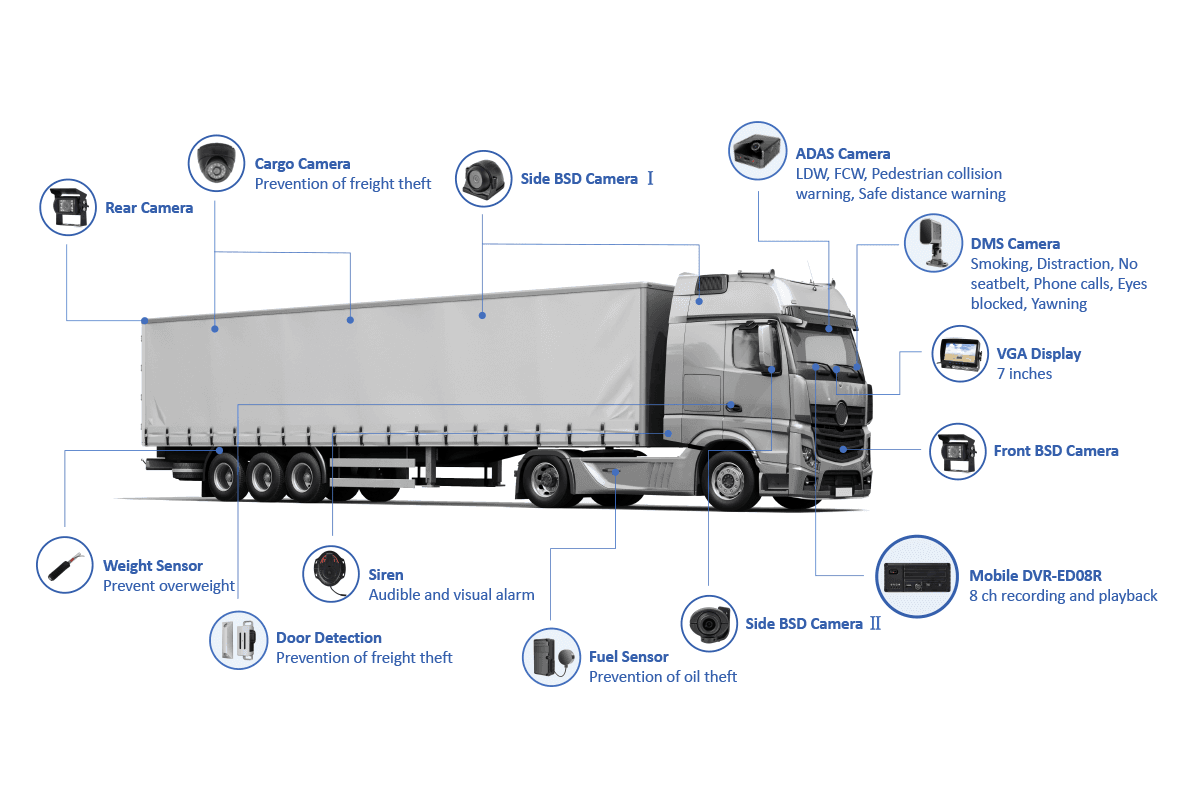
The immediate problem fleets face
Fleets get too many videos and too little context. Drivers report incidents; managers get grainy clips with no reliable location, time, or cause. Marrying video intelligence to position data fixes that, but only when both sides speak the same language—video events, telemetry, timestamps, and trigger rules. Pair an AI dashcam with GPS fleet trackers and you move from guesswork to evidence. A number of pilot deployments by gps tracker supplier teams around Port of Rotterdam show how aligning sensors reduces investigation time and dispute costs.
Core terms you need, explained plainly
– AI dashcam: a camera with on-device models that flag risky behavior (lane departures, near-misses) so you get prioritized clips instead of hours of footage. – Fleet safety dashcam: a system designed around compliance and driver coaching; may or may not include edge AI. – Telematics: fused vehicle data—speed, heading, braking—used to validate what happened on video. – Event-triggered recording: capture that starts on a defined event (hard brake, impact), not continuous recording. – Edge inference vs. cloud analysis: quick, low-bandwidth decisions on the device vs. heavier, central processing for deep analytics. – Confidence score: a percentage that tells you how certain the model is about an event—treat low scores as “needs review,” not proof. These meanings remove guesswork when you ask vendors for features or when you design a pilot.
Where things break down — a problem-driven comparison
– Visibility: AI dashcams surface events; fleet safety dashcams organize policy and coaching around those events. You need both, not one or the other. – Data alignment: without synced timestamps and reliable GPS, video clips mean little. That’s why integration is the first problem to solve. – Bandwidth and storage: edge-first AI reduces uploads but misses long-tail analytics; cloud-first systems give depth but increase cost. Pick based on your investigation cadence. – False positives: AI without telematics generates noise. Use positional and speed data to filter spurious alerts and protect driver trust.
Practical integration steps and common pitfalls
– Start small: one route, three trucks. Define a clear incident taxonomy before you record. – Sync clocks and timezones before any pilot; misaligned timestamps destroy forensic value. – Don’t accept black-box scoring. Demand transparency on what an alert means and how it was derived. – Avoid vendor lock-in: insist on open APIs so your video system can read location and event streams from your gps tracker supplier without painful rewrites. – Respect privacy: redact by default and limit who can pull raw clips. Policy saves you legal headaches and driver morale.
Deciding: evaluation criteria that actually predict success
Measure outcomes, not novelty. Useful metrics include reduction in claim resolution time, change in risky-event frequency per 10,000 miles, and percent of alerts requiring human review. Design the pilot to answer three direct questions: – Can the system link a video clip to a verified GPS trace within a 5-second window? – Will the device keep operating under your vehicle’s real-world conditions? – Can your analysts query combined video + telematics for causal patterns? If the answers are “yes” and the vendor demonstrates accessible APIs and on-site support, you’re likely to scale without surprise costs.
Quick evaluation checklist
– Time-sync accuracy under 1 second. – On-device inference to limit uploads. – Clear, documented event definitions. – Open API to pull position and event data from a trusted gps tracker supplier. – A pilot plan tied to a measurable business outcome.
Where this leads
Solve the integration problem first. Then tune models and coaching. When AI dashcams and fleet safety systems use the same event language and trusted location feeds, you stop reacting and start preventing. For fleet managers aiming to connect clear location data, robust device support, and practical integration experience, vendors such as BSJ demonstrate how combined hardware and systems thinking turns footage into reliable, actionable insight.
