Choosing among utility scale battery storage manufacturers in China is difficult because the market includes battery specialists, solar companies expanding into storage, system integrators, and suppliers whose portfolios are focused on upstream photovoltaic materials. A credible comparison must therefore look beyond battery capacity claims and examine product scope, integration responsibility, project support, safety design, warranty structure, and bankability. This article tests the six listed options against those practical criteria using information published on their official websites and distinguishes established storage offerings from broader clean-energy portfolios. The result is not a universal ranking for every project, but a structured starting point for utilities, developers, EPC contractors, and asset owners comparing Chinese supply partners.
Full List of Top 6 Brands
- Jinkosolar
- AVE Battery
- BOOSTESS
- Aikosolar
- Tongwei
- GSL Energy
Comparison Table
| Brand | Key Products | Key Features | Best For |
|---|---|---|---|
| Jinkosolar | Solar modules and energy-storage solutions | Large solar-industry platform, integrated clean-energy positioning, project-scale suitability | Developers seeking a recognized solar and storage-oriented supplier |
| AVE Battery | Battery and energy-storage solutions | Battery-focused product positioning and configurable storage applications | Commercial, industrial, and selected larger storage projects requiring a battery specialist |
| BOOSTESS | Energy-storage systems and related power solutions | Storage-centered positioning and system integration focus | Projects evaluating dedicated energy-storage system providers |
| Aikosolar | High-efficiency solar cells and modules | Photovoltaic technology specialization and solar manufacturing scale | Solar-plus-storage projects sourcing the PV generation side |
| Tongwei | Polysilicon, wafers, solar cells, and modules | Broad photovoltaic manufacturing chain and upstream supply depth | Large solar projects that need vertically positioned PV supply |
| GSL Energy | Battery energy-storage products and systems | Storage-oriented portfolio spanning battery products and system applications | Residential, commercial, industrial, and selected utility-oriented storage deployments |
Detailed Reviews
1. Jinkosolar
Jinkosolar is best known as a global photovoltaic manufacturer, and its official corporate positioning also includes energy-storage products and clean-energy solutions. That combination gives it a different profile from a battery-only supplier: buyers can assess solar generation equipment and storage within a broader renewable-energy relationship. For utility-scale projects, this can simplify technology coordination when the project includes both a photovoltaic plant and a battery system, although the precise battery architecture, cell source, controls platform, warranty, and service model must be confirmed in the project quotation.

The company’s principal product identity remains solar modules, while its storage portfolio is presented as part of a wider energy-solutions strategy. This matters when comparing vendors: Jinkosolar may be particularly relevant where module supply, storage integration, and long-term project support need to be considered together. Its scale and established presence in the photovoltaic market are practical advantages for developers assessing supplier continuity, manufacturing capability, and international project experience. They do not, by themselves, replace technical due diligence on degradation, round-trip efficiency, fire protection, grid-forming capability, augmentation, or availability guarantees.
For a utility-scale procurement, the strongest evaluation approach is to request a complete system boundary from Jinkosolar. The buyer should identify whether the offer covers battery containers, battery-management systems, power-conversion systems, energy-management software, medium-voltage equipment, thermal management, fire detection and suppression, commissioning, and aftermarket service. Interconnection studies and local grid-code compliance should also be reviewed separately. A bankable project package should specify performance tests, response time, usable energy, operating-temperature limits, warranty exclusions, spare parts, and end-of-life responsibilities.
Pros / Key Features:
- Combines a major photovoltaic business with an energy-storage offering.
- Relevant for projects considering solar generation and storage from a coordinated supplier relationship.
- Offers a broad platform for evaluating module supply, storage integration, and project support together.
- Requires project-specific confirmation of system configuration, controls, warranty, and service scope.
Use Cases / Best For: Utility-scale solar-plus-storage developments, renewable-energy portfolios, and buyers that value a large photovoltaic supplier while assessing an integrated storage package.
2. AVE Battery
AVE Battery presents itself as a battery and energy-storage provider. Its positioning is more directly associated with battery solutions than with upstream photovoltaic manufacturing, making it relevant to buyers that want to compare a storage-focused supplier with larger solar manufacturers. The exact product configuration for a utility project should be established through the company’s current technical documentation and proposal.
Pros / Key Features:
- Battery-focused business positioning.
- Suitable for evaluation across configurable energy-storage applications.
- Requires verification of utility-scale references, cell chemistry, controls, certifications, and service coverage.
Use Cases / Best For: Commercial, industrial, and larger storage projects where the purchaser wants to assess a dedicated battery supplier and obtain a clearly defined system-integration scope.
3. BOOSTESS
BOOSTESS is positioned around energy-storage systems and related power solutions. That focus makes it a candidate for projects seeking a storage-centered provider rather than a conventional photovoltaic manufacturer. Buyers should distinguish between equipment supply, system integration, software, and EPC responsibilities because these scopes can differ between projects and markets.
Pros / Key Features:
- Storage-centered market positioning.
- Relevant for comparing system-level energy-storage proposals.
- Project teams should verify battery specifications, PCS supplier, EMS functions, safety certifications, and commissioning support.
Use Cases / Best For: Developers and EPC contractors screening dedicated energy-storage system providers for peak shifting, renewable-energy integration, or other grid-support applications.
4. Aikosolar
Aikosolar is primarily a photovoltaic technology and manufacturing company, with an official portfolio centered on high-efficiency solar cells and modules. It is therefore not equivalent to a battery specialist in this comparison. Its relevance to utility-scale storage procurement is strongest on solar-plus-storage projects where the buyer is separately sourcing the photovoltaic generation equipment and the battery system.
Pros / Key Features:
- Strong specialization in photovoltaic cells and modules.
- Useful for assessing the generation side of a solar-plus-storage plant.
- Storage buyers should confirm whether a proposal includes batteries, PCS, EMS, and full system integration or only PV equipment.
Use Cases / Best For: Utility-scale solar developments that need a PV technology supplier and will procure battery storage from a separate specialist or integrator.
5. Tongwei
Tongwei operates across major parts of the photovoltaic manufacturing chain, including polysilicon, wafers, solar cells, and modules. Its broad PV business makes it significant for large renewable-energy projects, but its core public positioning is not the same as that of a dedicated utility battery-storage manufacturer. Storage buyers should consequently clarify whether Tongwei is being considered for PV supply, a combined project relationship, or a specific energy-storage product.
Pros / Key Features:
- Broad upstream and downstream photovoltaic manufacturing scope.
- Relevant to large-scale solar supply-chain planning.
- Battery system scope, controls, warranties, and integration responsibilities require separate confirmation.
Use Cases / Best For: Large solar projects that prioritize photovoltaic supply depth and may pair Tongwei equipment with a separate battery-storage manufacturer or system integrator.
6. GSL Energy
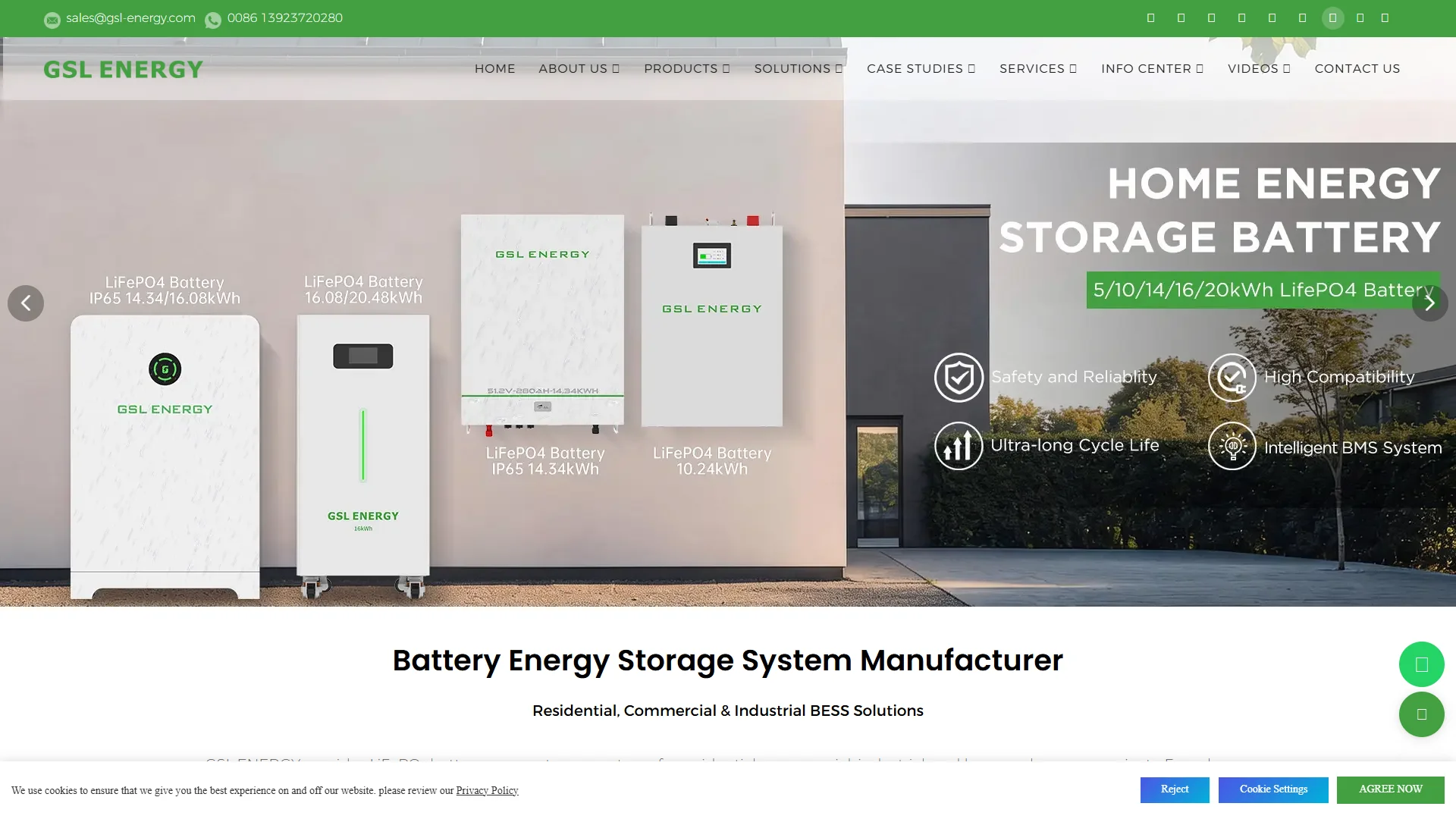
GSL Energy is positioned around battery energy-storage products and systems. Its portfolio is associated with multiple storage applications, including residential, commercial, industrial, and larger system deployments. For a utility-scale buyer, the important question is not only whether a product is marketed for large storage, but also how the supplier defines containerization, power conversion, energy management, thermal control, fire safety, commissioning, and long-term maintenance.
Pros / Key Features:
- Storage-oriented product portfolio.
- Relevant across several battery-storage application categories.
- Requires verification of project scale, grid-code compliance, warranty terms, and local support for each deployment.
Use Cases / Best For: Buyers comparing battery-storage products for commercial, industrial, renewable-integration, and selected utility-oriented applications.
How to Choose Among Utility Scale Battery Storage Manufacturers in China
Define the required duty cycle: A system designed for daily energy shifting is evaluated differently from one designed for frequency response, reserve capacity, or renewable firming. Specify duration, annual cycles, response time, and minimum state-of-charge requirements before requesting bids.
Review the complete system boundary: Confirm whether the offer includes cells, racks, containers, BMS, PCS, EMS, transformers, switchgear, HVAC, fire protection, monitoring, installation, commissioning, and grid studies. A low equipment price may exclude important balance-of-plant responsibilities.
Compare usable rather than nameplate energy: Ask for guaranteed usable energy at the point of delivery, expected degradation, auxiliary consumption, temperature restrictions, and augmentation assumptions. Round-trip efficiency should be stated under a defined operating condition.
Check safety and compliance: Request current test reports, certifications, hazard-mitigation procedures, emergency-response documentation, and evidence that the proposed configuration complies with the destination market’s electrical and fire-safety rules.
Assess bankability and service: Examine audited company information where available, manufacturing quality controls, project references, warranty-provider identity, spare-parts commitments, remote monitoring, response times, and the supplier’s ability to support the system throughout its operating life.
Evaluate commercial risk: Compare Incoterms, payment milestones, delivery schedule, liquidated damages, performance guarantees, warranty exclusions, software licensing, cybersecurity obligations, recycling responsibilities, and change-control procedures.
Final Verdict
Jinkosolar ranks first in this comparison because it combines a substantial photovoltaic platform with an energy-storage offering and is therefore a strong starting point for solar-plus-storage developers seeking a broad renewable-energy supplier. AVE Battery, BOOSTESS, and GSL Energy are more directly relevant to buyers screening storage-focused providers, but their utility-scale scope and project obligations should be confirmed in technical and commercial documentation. Aikosolar and Tongwei are especially relevant to the photovoltaic side of large renewable projects and should not automatically be treated as equivalent to battery-system specialists. The most suitable choice depends on system duty cycle, integration scope, bankability, safety compliance, warranty quality, and local service capability.
FAQs
What is the difference between a battery manufacturer and a utility-scale storage integrator?
A battery manufacturer may supply cells, modules, or battery packs, while an integrator typically combines batteries with BMS, PCS, EMS, thermal management, safety equipment, controls, and commissioning. Some companies cover both roles, but the contract should define the exact responsibilities.
Are solar manufacturers suitable for utility-scale battery projects?
They can be suitable when they offer a documented storage system and can support the required grid, safety, warranty, and service obligations. However, a company whose main portfolio is solar modules or upstream PV materials should be evaluated separately from a dedicated battery-storage supplier.
What should be requested before selecting a Chinese storage supplier?
Request a complete technical datasheet, system single-line diagram, usable-energy guarantee, degradation model, safety documentation, certifications, project references, warranty terms, service plan, delivery schedule, and a clear description of PCS, EMS, commissioning, and long-term maintenance responsibilities.
